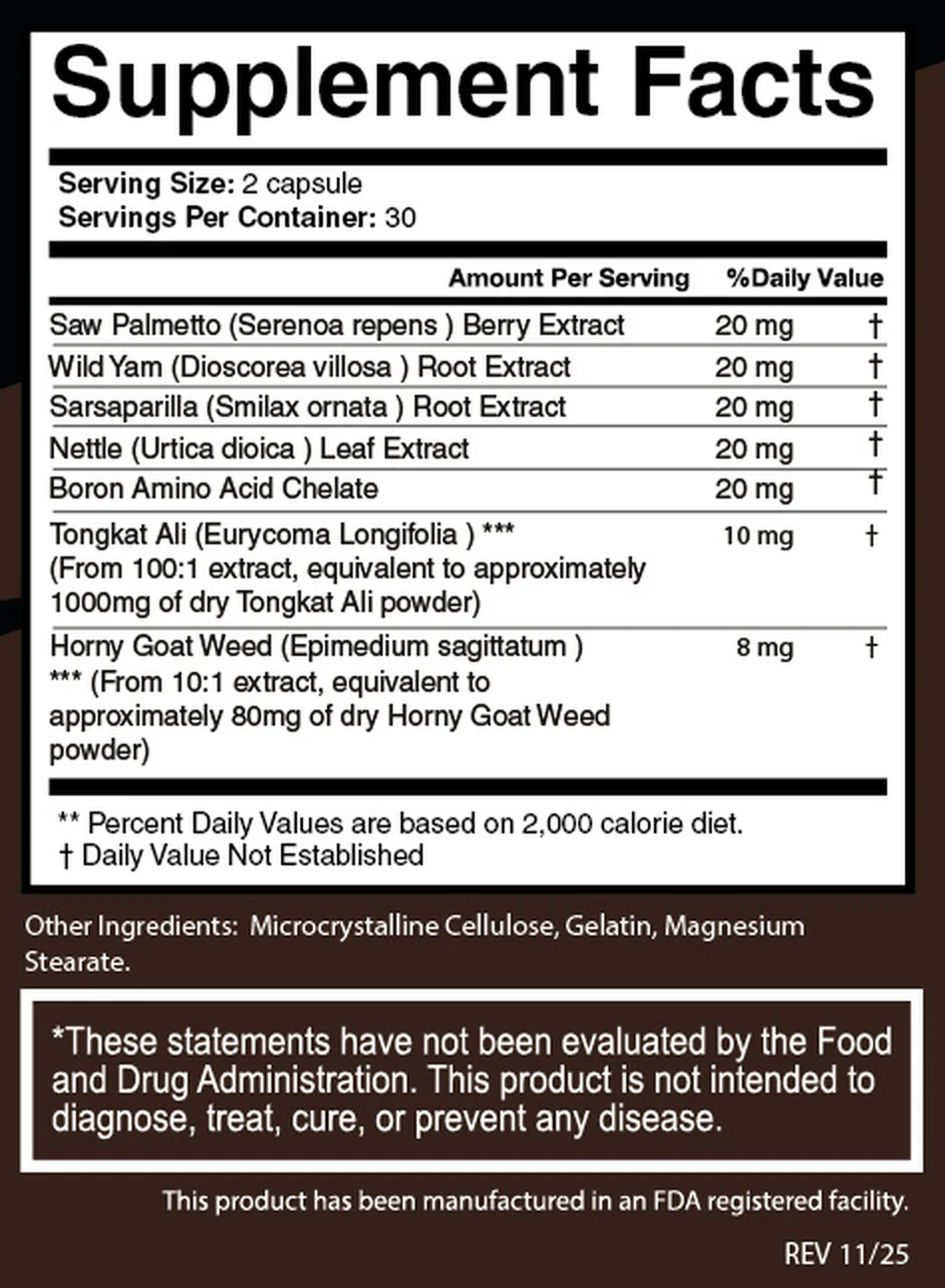
Seven cards, one per entry, in label order. Each card gives the printed HorseWood amount, the job it is doing in the HorseWood formula, and how that amount compares with the intakes used in published research.
Prostate
Ingredient 01
Saw Palmetto Berry Extract
20 mg per two capsule serving
Saw palmetto is the most studied plant on the HorseWood panel, and almost all of that work was done at 320 mg a day of a fat soluble berry extract in men with an enlarged prostate. The HorseWood label prints 20 mg. That is a sixteenth of the studied intake, so treat it as a nod toward urinary comfort rather than a reason to skip a urologist. Men already taking finasteride or an alpha blocker should show this bottle to their doctor before adding it.
Tradition
Ingredient 02
Wild Yam Root Extract
20 mg per two capsule serving
Wild yam carries diosgenin, and diosgenin is the raw material chemists once used to build steroid hormones in a laboratory. The human body does not run that reaction. Any page telling you the wild yam in HorseWood converts into testosterone or DHEA inside you is selling a lab process as biology. What is left in HorseWood is a traditional root with a mild reputation for cramping and menopausal complaints, and very little controlled evidence in men.
Tradition
Ingredient 03
Sarsaparilla Root Extract
20 mg per two capsule serving
Sarsaparilla was the tonic of nineteenth century pharmacies and it still trades on that name. Its saponins are interesting in test tubes for how they interact with proteins in the gut, and there is a long folk record behind it. Controlled human trials in men are effectively absent, and HorseWood does not pretend otherwise. HorseWood includes it at 20 mg, and the fair description is traditional support rather than a proven mechanism.
Prostate
Ingredient 04
Nettle Leaf Extract
20 mg per two capsule serving
The detail worth catching on the HorseWood label is the plant part. The prostate research men have read about was run on nettle root, often at 300 mg to 600 mg a day and often beside saw palmetto. This panel prints nettle leaf, which is the part used for hay fever and joint complaints, with a different chemistry. It is not a mistake, but it is not the ingredient most buyers assume they are getting either.
Hormone
Ingredient 05
Boron Amino Acid Chelate
20 mg per two capsule serving
Boron is the entry with the cleanest human story on the HorseWood panel. Small trials at roughly 6 mg to 10 mg a day of elemental boron have moved free testosterone and lowered estradiol over one to two weeks in men. The catch is that HorseWood prints 20 mg of an amino acid chelate, and a chelate is mostly carrier. The elemental boron inside is not printed, so nobody outside the manufacturer knows whether it reaches the studied range.
Hormone
Ingredient 06
Tongkat Ali 100:1 Extract
10 mg per two capsule serving
Tongkat ali is the reason most men look at a bottle like HorseWood in the first place. Human trials on fatigue, mood and free testosterone usually run 200 mg to 400 mg a day of a standardised extract for one to three months. HorseWood prints 10 mg of a 100:1 concentrate and states it as equivalent to about 1000 mg of dry root powder. That equivalence is the manufacturer's arithmetic on the raw material, not a measurement of active compounds, and dry root is not the same thing as a standardised extract.
Desire
Ingredient 07
Horny Goat Weed 10:1 Extract
8 mg per two capsule serving
Epimedium earns its nickname from a marker compound called icariin, which behaves in laboratory work a little like the drugs prescribed for erectile difficulty, but far more weakly and mostly in animals. HorseWood prints 8 mg of a 10:1 extract, stated as roughly 80 mg of dry powder. Human evidence at any dose is thin, and at this HorseWood amount the honest label is traditional support. Anyone taking nitrates or blood pressure medication should ask a doctor first.